


After years of walking clients through inheritances, business sales, bonuses, and liquidity events, we have seen how these moments unfold in remarkably consistent ways. There is almost always a boat, or something like one. A vacation home. A renovation. A car that was never quite justified before. None of it is wrong on its own. But how a windfall is handled in the months immediately following its arrival often determines whether it becomes the foundation for something lasting or whether short-term decisions quietly limit the outcomes that could have been possible.
A client calls us, voice equal parts excited and anxious. They let us know they’re receiving a large inheritance. Or their company was acquired. The number they’re about to receive can be life-changing by any measure.
What happens next? In the weeks that follow, we’ll see the full range of human nature: the disciplined and the impulsive, the generous and the fearful. And after working a long time as financial professionals, we’ve noticed that people’s instincts in the first 90 days can often determine whether a windfall becomes a foundation for generational wealth or a brief episode in their financial story.
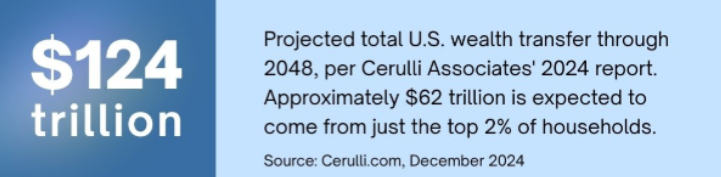
With the largest wealth transfer in American history now actively underway, Cerulli Associates projects that $124 trillion in assets will change hands through 2048, with nearly $100 trillion flowing from Baby Boomers and the Silent Generation to their heirs.1
When the transfer happens, the conversation is no longer hypothetical; it becomes immediately real for many families. If you haven’t personally experienced a windfall yet but think you may at some point, it makes sense to start preparing.
We’re not writing this to lecture anyone. We’re writing it because we’ve seen what works and what doesn’t. We hope the patterns we share here make it easier for you, and the people you care about, to navigate one of life’s genuinely complicated moments.
The First 90 Days: Where Windfalls Are Won or Lost
Whether it’s an inheritance or a business sale, one of the single most important things to consider after receiving a financial windfall is to pause before making any major financial decision. The first 90 days are almost always the most consequential and are often when people make common mistakes, as early emotion may outpace strategic thinking.
There’s a psychological phenomenon that behavioral finance researchers call the “house money effect.” This is a well-documented tendency for people to treat unexpected money as fundamentally different from money they’ve earned, often leading to greater risk-taking and more impulsive spending.2
The rational part of our brain knows that a dollar is a dollar regardless of its origin. But emotionally? Windfall money often feels like “bonus” money, so it’s treated accordingly.
Here’s what we often see in those early weeks:
- Lifestyle upgrades that happen faster than other factors are considered.
- Loans to family members are made under emotional pressure before any strategy is in place.
- Investment decisions can be made on a hot tip from anyone, from a brother-in-law to a podcaster.
- Money is spent on a vacation, a renovation, or a new car (often all three simultaneously).
- Nothing for too long. Complete paralysis occurs because the number feels too large to touch.
That last one surprises people. But analysis paralysis is common, particularly with large inheritances, where the emotional weight of a loved one’s death makes the money feel both precious and untouchable, so the cash sits in a bank account not producing a return for an extended period.

The 5 Patterns We See Most Often
Even though all of our clients over the years have been unique, and we help each craft a personalized financial strategy, we do see patterns emerge that we address and try to course-correct when it comes to sudden changes in wealth.
1. The Lifestyle Leap
The most common pattern of all. The new house gets bought, the cars get upgraded, and the vacation budget suddenly doubles or triples. None of these things are inherently wrong, but we’ve watched more than a few clients make lifestyle commitments that require ongoing income to maintain, only to find that the windfall itself may not generate enough return to sustain that newly lavish lifestyle forever.
A client once received a $3.5 million inheritance and, over the following 18 months, committed to a vacation home, a boat, private school tuition for three children, and a home renovation. The commitments were entirely serviceable, but they locked up more than half the principal and created ongoing carrying costs of roughly $180,000 per year. A windfall that could have been generational became merely comfortable.
“Comfortable” is fine. But take the time to understand the trade-offs.
2. The Family First Impulse
Generosity is one of the most beautiful things about a windfall. And the pressure to share it (from adult children, siblings, parents, and old friends) can be intense. The reality check: 72 percent of Americans say they don’t feel confident in their ability to manage a large financial windfall.3
Yet those same people often feel quite confident in their ability to give it away.
We’re not suggesting that gifting is wrong. In fact, strategic gifting is one of the most powerful tools in an estate strategy. But there’s a difference between a thought-out gifting strategy (with proper documentation, tax awareness, and investment in the recipient’s financial education) and writing checks in the first few weeks because saying no feels stingy and impossible.
For 2026, the annual gift tax exclusion is $19,000 per person (or $38,000 for married couples giving jointly).4
These are amounts that can be given without touching the exemption for lifetime gifts. Your tax, legal, or accounting professional can offer some insights.
3. The DIY Investor
Some people who receive a windfall consider becoming a do-it-yourself investor, often underestimating the complexity involved. Windfalls have a way of generating investment confidence and that “playing with house money” effect. Someone receives $800,000 and suddenly feels they should manage it themselves, perhaps because asking for help feels like admitting they don’t know what they’re doing.
The data here is not encouraging. Only 20 percent of Americans say they would seek guidance from a financial professional after receiving a windfall.5
This could be short-sighted, because making investment decisions isn’t always easy or intuitive, particularly if you’ve never done it before. A financial professional will work with you to understand your goals, time horizon, and risk tolerance before suggesting an overall financial strategy.
4. The Paralyzed Inheritor
Sudden wealth syndrome, a term first identified by psychologist Stephen Goldbart in the 1990s, describes the psychological and emotional distress that can accompany an unexpected windfall.6
It’s real, and it’s more common than most people expect. Symptoms include anxiety, guilt, social isolation, and difficulty trusting the motives of people around them.
For many inheritors, the grief of losing a parent or loved one is bound up with the windfall itself. The money arrives at the worst possible emotional moment. Making decisions feels like desecrating something sacred. So nothing happens, sometimes for years. If you haven’t yet, consider the emotional toll of cleaning out and selling the family home where you were born and raised. It’s understandable for some to want to avoid tackling that piece of a windfall.
The cost of paralysis is real. What may help? Having a trusted financial professional who is a neutral party take some of the administrative burden off in the early months while creating a gentle structure for decision-making. The finances can wait for a while. The grief shouldn’t have to.
5. The One Who Gets It Right
There is a fifth pattern, and it’s the one we steer our clients toward. It’s when the client pauses for an appropriate amount of time, assembles a team of professionals, thinks carefully about what this money is actually for, reaffirms their values and goals, and then builds something that can outlast them.
These clients tend to share a few traits: they’re willing to talk honestly about money with their family, they’re curious rather than embarrassed about what they don’t know, and they have a clear sense of what they actually want their wealth to do. They give intentionally. They invest strategically. They think generationally. They take care not to increase their recurring lifestyle expenses.
Why This Conversation Is More Urgent Than Ever
We’re in the middle of the largest generational wealth transfer in recorded history. According to Cerulli Associates’ 2024 report, more than 50 percent of the total projected transfer (approximately $62 trillion) will come from high-net-worth and ultra-high-net-worth households.1
And $18 trillion of it is expected to flow to charitable causes.
Gen X will inherit the greatest amount in the next decade (projected at $14 trillion) at a pivotal life stage when many are simultaneously caring for aging parents and still financially involved with adult children. Millennials, meanwhile, are projected to be the largest inheritors over the full 25-year period, receiving an estimated $46 trillion.7
These numbers matter not just as statistics but also as a strategic reality for every family. If you’re in your 50s or 60s and your parents are aging, the question is no longer “will this happen?” It’s “Are we prepared when it does?”
And if you’re on the giving side of this transfer, the question is equally important: Have you set your heirs up to receive your wealth wisely? You already know they don’t want your wedding china or Hummel collection, but have you had the financial conversations? Have you structured your estate to reflect your values, not just your balance sheet?
What Actually Works: A Framework for Windfall Decisions
After years of watching these events unfold, we’ve developed a straightforward framework that we walk clients through whenever a windfall event is on the horizon or has just arrived.
Step 1: Secure Before You Decide
The first step after receiving a windfall is to receive the funds without committing them to anything. Give yourself permission to simply breathe.
Step 2: Get the Right People in the Room
Consider working with a team of professionals before making any decisions. These conversations can help you start to create an overall strategy for the windfall.
Step 3: Name the “Why”
What is this money actually for? Retirement? Helping your children? Creating a legacy? A mix of everything? Clients who can articulate a clear purpose for their windfall are often better equipped to make the dozens of smaller decisions that follow; without a “why,” every decision can feel equal and arbitrary.
Step 4: Cover the Basics
Before making any major decisions, it’s always a wise idea to look at your overall financial picture. This can include reviewing any high-interest debt or other obligations.
Step 5: Build a Spending Permission Slip
One of the healthiest things we do for clients who receive a large windfall is to encourage them to designate a small percentage (often 3 percent to 5 percent) explicitly for guilt-free enjoyment. A trip. A renovation. A gift to each adult child. Having a defined way to enjoy the money can help with the psychological pressure that leads to big, impulsive decisions.
The Bottom Line
A financial windfall is one of the few moments where the decisions you make in a short window can genuinely alter the trajectory of your family’s financial story, for better or for worse.
Frequently Asked Questions About Financial Windfalls
- How long should I wait before investing money from an inheritance or windfall?
Consider waiting for a period of time, perhaps 90 days, before making any decisions. Assemble your professional team, understand the implications of certain decisions, and clarify your goals.
- What are the biggest financial mistakes people make after receiving a windfall?
The five most common mistakes we see are making large lifestyle commitments before a strategy is in place, giving money to family under emotional pressure, attempting to manage the money without professional guidance, making no decisions at all due to paralysis or grief, and failing to address the tax implications in the first year.
- Do I need to work with professionals if I receive a large inheritance?
Professionals can help you develop a long-term strategy aligned with your goals. A tax, legal, or accounting professional can help you address your tax situation. An estate attorney can help with your estate strategy. If you don’t already work with a team of professionals, it may be time to consider doing so.
- What taxes do I owe on an inheritance or windfall?
Tax treatment varies by windfall type. Every windfall situation has a unique tax profile, which is why consulting a tax, legal, or accounting professional can be so helpful. A financial professional can also play a role, and an estate attorney may be helpful, too.
We’re Here for You Before, During, or After a Windfall
As financial professionals, we are here to help you navigate your entire financial life, including any sudden change in your wealth. A windfall can be a great thing, but it also brings its own complexities and stresses that we need to address carefully. Please don’t hesitate to reach out to start a discussion.
Sources:
- Cerulli.com, December 2024
https://www.cerulli.com/press-releases/cerulli-anticipates-124-trillion-in-wealth-will-transfer-through-2048 - PMC PubMed Central, April 2026
https://pmc.ncbi.nlm.nih.gov/articles/PMC12272607/ - CitizensBank.com, April 2026
https://www.citizensbank.com/learning/great-wealth-transfer-survey.aspx - Glenmede.com, December 22, 2025
https://www.glenmede.com/insights-private-wealth/the-great-generational-wealth-transfer/ - Empower.com, April 13, 2026
https://www.empower.com/the-currency/money/spending-a-windfall-research - CAPTrustAtWork.com, April 2026
https://www.captrustatwork.com/suddenly-in-the-money/ - Fortune.com, July 23, 2025
https://fortune.com/2025/07/23/great-wealth-transfer-124-trillion-bigger-than-ever-millennials-gen-x/