


Studying abroad is one of the most formative investments a family can make.
The financial side, however, often gets less attention than it deserves. In the most recent academic year, 298,180 U.S. students studied abroad for academic credit, a 6 percent increase from the prior year. They spent their semesters across more than 170 destinations worldwide. While those students share many of the same types of enriching experiences, what varies is how prepared their families were financially to give them the opportunity.1
The Cost of Studying Abroad
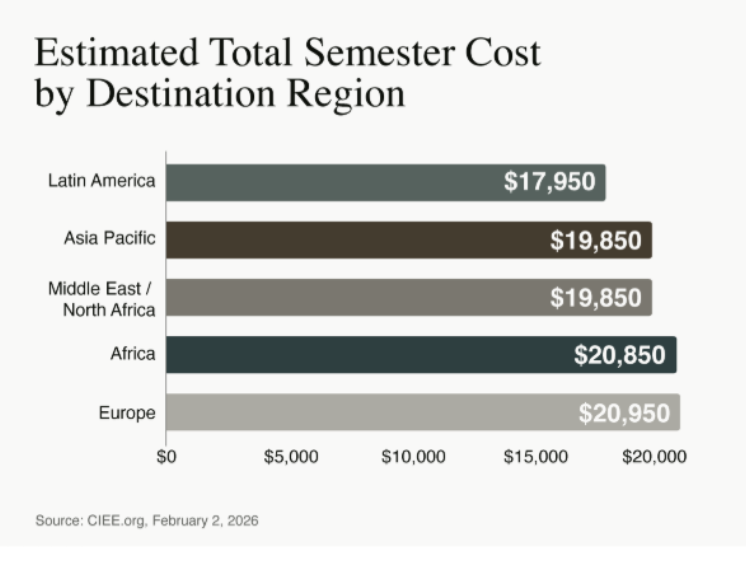
Most families start with the headline program fee and assume it tells the full story. A semester abroad through a third-party provider typically runs $15,000 to $22,000, which usually covers tuition and housing. The all-in average expenses can be higher once out-of-pocket costs like airfare, visas, and daily meals are factored in. Direct enrollment at a foreign university varies by country. Germany’s heavily subsidized public universities cost a fraction of a semester in London, while Japan, Australia, and most of Western Europe sit in a higher range.2,3
Research shows that families encounter unexpected financial blind spots. Expenses include airfare, airport transport, bedding, groceries, a local transit card, and basic setup costs. And these early extra costs all land at once. Overseas programs encourage students to build a budget from the official cost and then add a cushion as a contingency. Having that structure in place before departure, rather than after the first credit card statement arrives, can make a difference.3
Using 529 Funds: The Rules That Can Trip Families Up
For families who have saved in a 529, the first question is usually whether those funds can be used for study abroad. The answer can be yes, but eligibility has real teeth. If a student goes abroad through their U.S. home institution’s study abroad program, the home school’s eligibility can extend to that semester, provided the credits count toward the student’s degree. If you have questions about eligibility, check with the school and consider speaking with your tax, legal, or accounting professional.4
What 529 funds cannot cover is equally important to know. Airfare, passport fees, and visa costs may not be considered qualified expenses, regardless of how essential they are to getting there. Also, a 529 distribution must occur in the same calendar year as the qualifying expense. For example, the timing of a December withdrawal applied to January-paid spring semester expenses can trigger unexpected fees. One action item to consider is verifying the specific institution or program against the Department of Education’s Federal School Code list before making any distribution and coordinating withdrawal timing with the actual payment schedule.4,5
Currency, Cards, and Moving Money Abroad
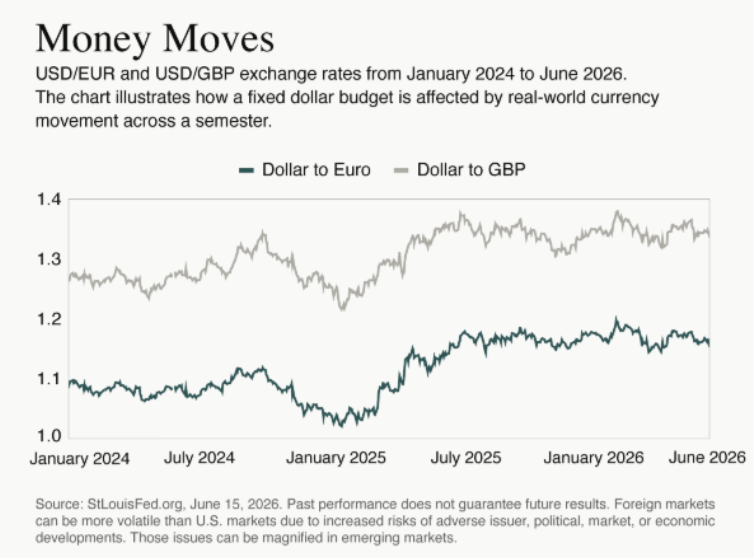
Standard international bank wire transfers carry outgoing fees, plus an exchange rate markup that can be hidden upfront. You may want to look into services that apply the mid-market rate and show all fees transparently, which might save some money over a full semester. Currency fluctuation adds another variable: a material shift can change how far a fixed monthly budget goes.6
Getting the appropriate card set up can be worth the time, especially if the student plans to rely on the card for most transactions. For family communication, popular apps and Wi-Fi calling tools that your children are probably already familiar with work in most countries and often cost nothing beyond the data connection.
Will Your Health Insurance Actually Cover Your Child Abroad?
Health insurance is one of the highest-stakes items in study abroad preparation and can get less attention than it deserves. Some U.S. health plans provide limited overseas coverage. Those that do offer international benefits on occasion require students to pay for care at the point of service, document everything, and file for reimbursement afterward, subject to benefit limits.
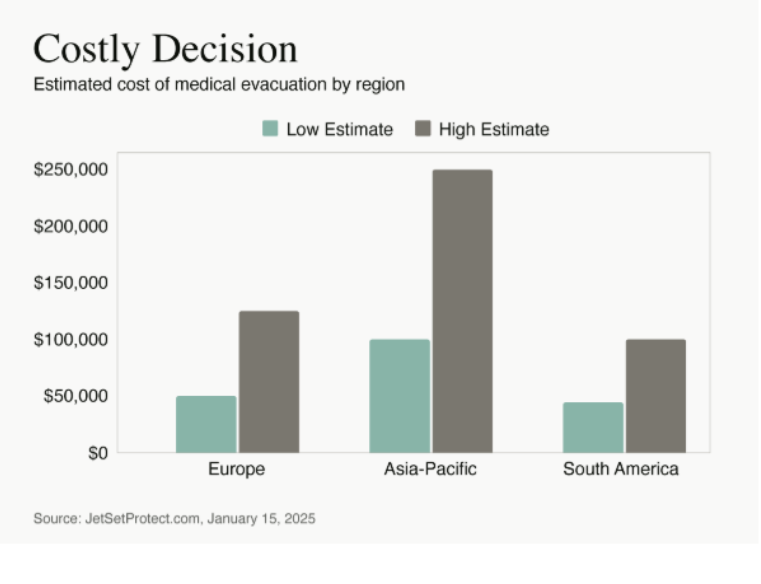
The financial exposure from a single medical event can be unexpected. Medical evacuation by air ambulance back to the United States can cost $20,000 to $200,000 depending on location and condition, and most domestic health plans provide no evacuation benefit at all. Other options include the host university’s international student health plan, a standalone policy from an international student insurer, or, for year-long stays, a short-term expat health plan. Whatever the choice, check to see if evacuation and repatriation coverage is included and have the policy number and 24-hour emergency line accessible before the student departs.7
Tax Obligations Most Families Don’t Know About
Two tax-related considerations should be addressed when studying abroad. The first is foreign bank account reporting. If a student opens a local bank account abroad and the aggregate value of all foreign financial accounts exceeds $10,000 at any point during the calendar year, a Foreign Bank Account Report (FBAR) may need to be filed with the Financial Crimes Enforcement Network. Check with your tax, legal, or accounting professional to see if this applies.8
The second is gift tax tracking. The annual gift tax exclusion is $19,000 per recipient for 2025 and 2026; a couple electing gift splitting can transfer up to $38,000 to a child in a calendar year. Some families sending a monthly living allowance will not approach this threshold, but consider keeping a running total against the exclusion so you have it at tax time.9
Why Students Tend to Overspend Abroad
One of the most consistent findings in behavioral finance is that psychological distance changes how we process financial consequences. Trope and Liberman’s Construal Level Theory established that the farther something is from our immediate experience, whether physically, socially, or emotionally, the more abstractly we think about it and the less vividly we feel the stakes. Money spent in an unfamiliar currency, far from home, in a context that feels exceptional, simply registers differently than money spent locally. That shift affects behavior in predictable ways.10
Digital payments can reduce the friction of spending, and an unfamiliar currency makes that effect even harder to notice. Add in the limited visibility parents have into daily spending and a tendency to rationalize overspending because the experience feels too important to constrain, and pre-departure budgets regularly get stretched. One approach to help manage is to set up a clear monthly budget, regular financial check-ins, and a dedicated account that gives everyone access to the account.
Budgeting is even more important when you factor in the tendency of students studying abroad in one country to take weekend trips to other destinations. For students spending a semester in London or Dublin, the temptation is strong to hop over to Paris, Rome, or Prague for a few days. Croatia and Morocco have also become popular destinations for U.S. college students looking for weekend excursions. While there are discount European airlines that offer cheap flights, the costs of these side trips can add up. Consider factoring a few of these into the overall budget, and you may not be surprised later. You may also consider making an agreement that the student will pay for some or all of these “extra” activities.
Before They Leave: The Financial Checklist
These items are worth working through before departure. Some take minutes; a few need more lead time. Getting ahead of all of them is worth the effort.
- Confirm 529 eligibility before any distribution. Verify the specific program or institution against the Department of Education’s Federal School Code List and confirm that withdrawal timing aligns with the calendar year of the qualifying expenses.
- Check to see if you can get a no-foreign-transaction-fee credit card in the student’s name. Having the card in the student’s name can help them build credit history and may help manage complications with a parent’s card.
- Establish a money transfer approach for regular living allowances. Try to locate a service that shows all fees upfront. A few minutes of comparison before the first transfer saves money across the whole semester.
- Consider building a full-cost budget. Include program fees, housing, food, local transport, airfare, visa costs, first-month setup expenses, and a realistic travel and social allowance. Better yet, ask for your student’s help.
- Review health insurance coverage. Contact the current insurer to understand what is covered internationally. Compare what the host university offers with standalone international student options, and confirm that evacuation coverage is included.
- Decide on the cell phone plan. For a full semester, a plan purchased in the host country may offer better value than U.S. carrier international day passes.
With preparation before departure, families can focus on supporting the experience rather than managing surprises from thousands of miles away. Let us know if you need any additional information, and we can point you in the right direction.
Frequently Asked Questions
Can We Use 529 Funds for a Program Run Through Our Child’s U.S. University?
If the home institution is eligible for Title IV federal student aid and the study abroad credits count toward the student’s degree, the program is generally treated as a qualified expense for 529 purposes. Confirm with the home university’s financial aid office and coordinate withdrawal timing to match the calendar year of the expenses being paid. Also, check in with your tax, legal, and accounting professional.
Will Our Health Insurance Cover a Medical Emergency Abroad?
Possibly in part, but rarely in a meaningful way. Most domestic U.S. health plans have limited international coverage, typically requiring out-of-pocket payment at the time of care and reimbursement filing afterward. Medical evacuation is generally not covered at all. Verifying coverage directly with the insurer and adding a dedicated international student health plan before departure is strongly advisable.
Does My Child Need to File an FBAR If They Open a Bank Account Abroad?
The rule applies to U.S. citizens of all ages, including minors. If a parent is funding the account with a regular allowance, monitoring the balance against that threshold is a straightforward step worth staying on top of. This is another item to review with your tax, legal, or accounting professional.
How Do We Manage the Risk of a Student Overspending Abroad?
Having a structure established before departure is the most effective tool for staying on track. Agree on a clear monthly budget together before the student leaves, including how many weekend travel excursions will be allowed. Set up a regular financial check-in, weekly or biweekly. Use a dedicated account funded with a monthly allowance rather than open access to a shared account, and choose a bank or app that gives both the student and a parent visibility into balances and transactions. The goal is not restriction. It is giving the student a framework that builds good financial habits in an environment where the usual guardrails are far away.
Sources:
1. OpenDoorsData.org, November 17, 2025.
https://opendoorsdata.org/annual-release/u-s-study-abroad/
2. SoFi.com, November 25, 2025.
https://www.sofi.com/learn/content/cost-of-study-abroad-programs/
3. CollegeInvestor.com, September 17, 2025.
https://thecollegeinvestor.com/63453/costs-of-study-abroad/
4. Schwab.com, November 14, 2025.
https://www.schwab.com/learn/story/how-to-use-your-529-funds-to-study-abroad
5. A 529 plan is a tax-advantaged education savings plan. Before choosing a plan, it’s important to consider not only the state tax treatment but also any associated fees and expenses. Availability of a state tax deduction will depend on your state of residence, as state tax laws and treatment may vary from federal tax laws. If you make nonqualified distributions, earnings will be subject to income tax and a 10% federal penalty tax. You may want to consult your tax, legal, or accounting professional when considering a 529 plan.
6. Wise.com, March 30, 2026.
https://wise.com/us/blog/international-wire-transfer-fees;
7. Travel.State.Gov, 2026.
https://travel.state.gov/en/international-travel/planning/guidance/medicine-health.html
8. IRS.gov, 2026.
https://www.irs.gov/businesses/small-businesses-self-employed/report-of-foreign-bank-and-financial-accounts-fbar
9. IRS.gov, 2026.
https://www.irs.gov/businesses/small-businesses-self-employed/frequently-asked-questions-on-gift-taxes
10. pmc.ncbi.nlm.nih.gov, 2026.
https://pmc.ncbi.nlm.nih.gov/articles/PMC3152826/