

Medicare Part B premiums for 2026 rose to $202.90 a month, an increase of $17.90 from 2025 and just under 10 percent. For higher earners, that increase compounds when a surcharge, called the Income-Related Monthly Adjustment Amount, or IRMAA, is added on top of the standard premium. IRMAA is not calculated on this year’s income. It is calculated on income from two years earlier, which means a growing number of new retirees are paying a Medicare surcharge based on a salary they no longer collect.1
Why Is Your 2026 Medicare Premium Based on Your 2024 Tax Return?
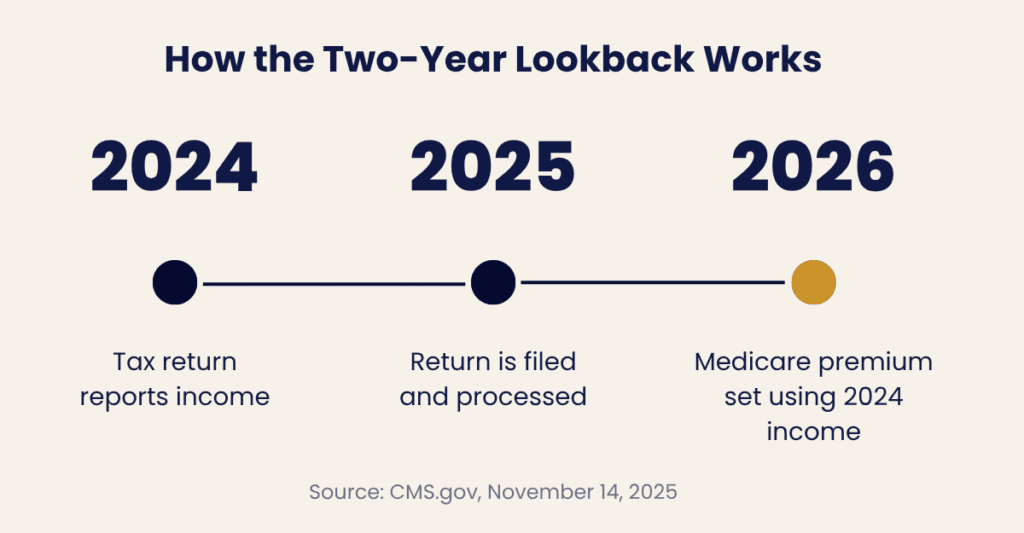
Since IRMAA began in 2007, the Centers for Medicare & Medicaid Services has set each year’s income-related surcharge using the tax return filed two years earlier. For example, your 2026 premium is based on the modified adjusted gross income (MAGI) reported on your 2024 return. If that return was not yet available, Social Security falls back to 2023.2
While the rule has been around for almost two decades, new retirees see it for the first time as they begin enrolling in Medicare.
How Much More Are Households Paying at Each Income Level in 2026?
If your MAGI reported on your federal tax return from two years ago is above a certain amount, you’ll pay the standard Part B premium and an income-related monthly adjustment amount.3
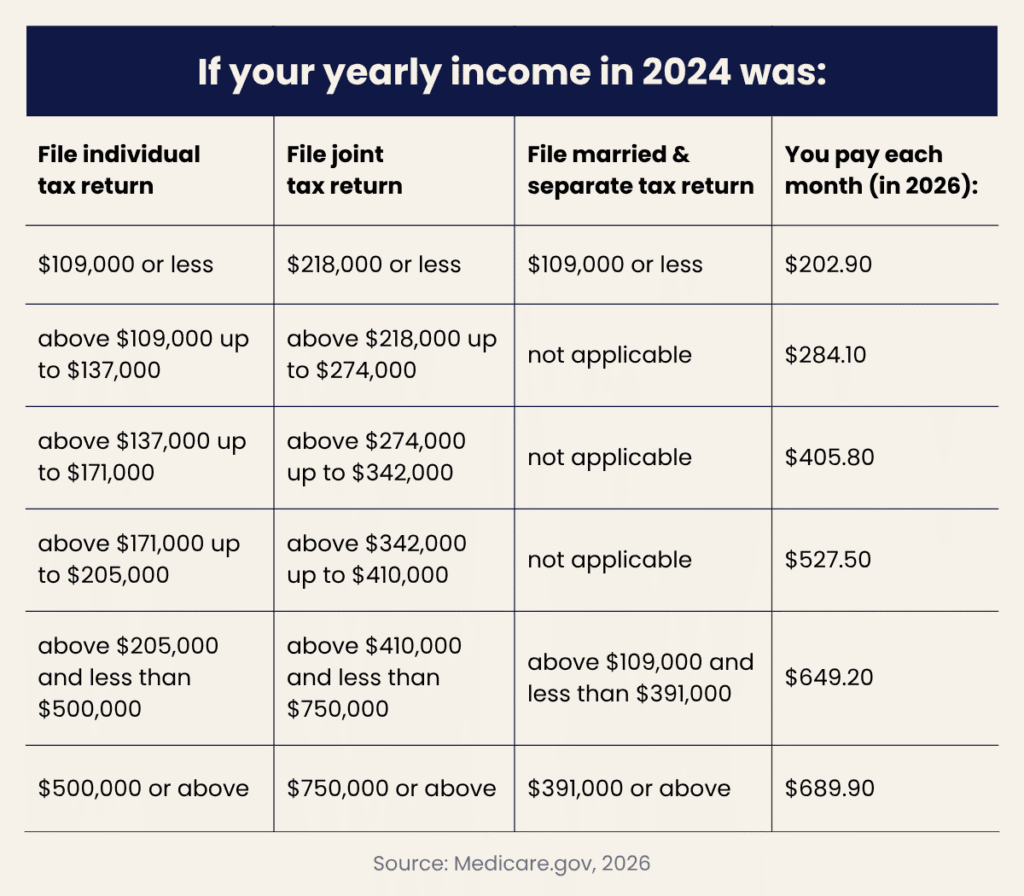
CMS estimates that about 8 percent of people with Part B, and a similar share of those with Part D drug coverage, pay one of these surcharges. Keep in mind that a pension combined with a required withdrawal from a retirement account is often enough to push a household’s MAGI past $109,000.1
Why Does One Extra Dollar Trigger Thousands in Extra Premium?
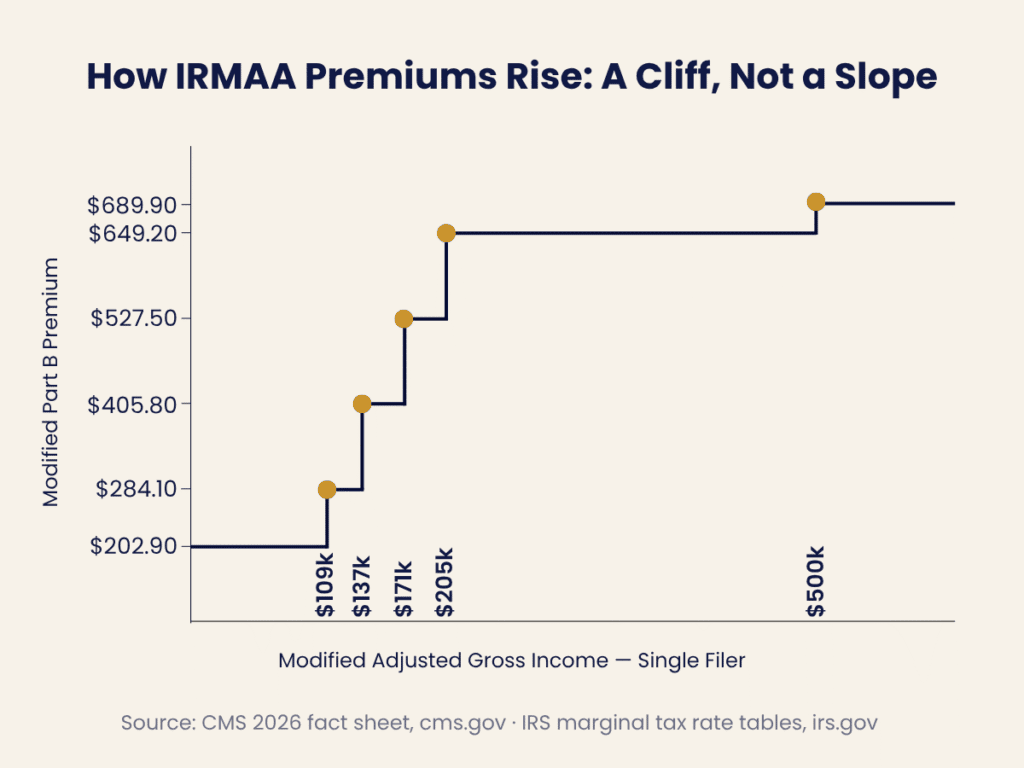
Every tier works the same way: as a cliff, not a slope. Income tax brackets are marginal, so crossing into a higher bracket only raises the rate on the income above the threshold. IRMAA does not work that way. Report one dollar more than $109,000 in MAGI as a single filer, and the surcharge for that entire tier applies for the full year, for both Part B and Part D. A single filer who reports $109,001 instead of $109,000 owes about $1,148 more for the year. A married couple who file jointly both get charged at once, since the same tax return sets both of their premiums, adding roughly $2,297 to their combined bill for a single extra dollar of reported income.3
The $500,000 single and $750,000 joint thresholds were set by the Bipartisan Budget Act of 2018. The lower brackets move up a little each year with the cost of living, but the top thresholds are expected to remain frozen until 2028.4
What Happens When Your Income Drops After That Tax Return Was Filed?
The two-year lookback assumes life stays fairly steady, and for many households approaching Medicare eligibility, it does not. Retirees can experience a drop in income, and it often lands in the same window as Medicare enrollment.2
Social Security has a form built for this exact mismatch: Form SSA-44, Medicare Income-Related Monthly Adjustment Amount, Life-Changing Event. It allows a beneficiary to ask Social Security to base the current year’s IRMAA on a more recent income figure instead of the two-year-old tax return, but only if the drop was caused by one of eight recognized events:2
- Marriage
- Divorce or annulment
- Death of a spouse
- Work stoppage, which includes retirement
- Work reduction
- Loss of income-producing property (for example, a rental home) due to uncontrollable events like natural disasters
- Loss of pension income
- An employer settlement payment tied to a bankruptcy or reorganization
This is for informational purposes only and is not a replacement for real-life guidance. Consult your tax, legal, or accounting professional if you believe filing an SSA-44 would be appropriate in your situation.
How Does Filing Form SSA-44 Work?
Social Security typically mails the initial IRMAA determination notice in late fall, listing both the income figure used and instructions for requesting a new determination. From that notice, a beneficiary has 60 days to request a reconsideration, while a life-changing event can be reported at any time during the year through Form SSA-44. Social Security generally takes several weeks to process a request, and premiums stay at the original, higher amount until a decision is made. If the request is approved, the difference is refunded or credited going forward.5
The form can be mailed, faxed, or dropped off in person at a local field office. Your tax, legal, or accounting professional may be able to help. But also consider working with your financial professional, who might be able to help you gather the information needed by the Social Security office.2

Why Do So Few People File a Form That Could Save Them Thousands?
Part of the reason is structural. Medicare Part B premiums, including any IRMAA surcharge, are usually deducted automatically from a Social Security benefit check before it is ever deposited. That makes the cost close to invisible.6
The other part is psychological. Once a figure comes from a federal agency, it tends to get treated as fixed, even when the agency itself has built a formal process for adjusting it. An invisible cost and a number that looks permanent are two reasons why the form is often overlooked.
How Our Firm Can Help
As part of retirement income preparation, we will look at your household’s projected MAGI so we can model what your income will look like. For Form SSA-44, we help review eligibility, gather documentation, and coordinate with your tax, legal, or accounting professional. Small timing decisions can make a big difference with retirement income.
Frequently Asked Questions
What counts as a qualifying life-changing event for Form SSA-44?
Social Security recognizes eight events: marriage, divorce or annulment, death of a spouse, work stoppage, work reduction, loss of income-producing property, loss of pension income, and an employer settlement payment tied to a bankruptcy. Retirement is treated as a work stoppage.
How long does it take Social Security to process an SSA-44 request?
Social Security says typically six to eight weeks. Premiums remain at the original amount during the review, and any overpayment is refunded or credited once a decision is made.
Do you need to refile Form SSA-44 every year?
Your tax, legal, or accounting professional can provide guidance here.
What if the income drop was not caused by one of the eight listed events?
Form SSA-44 may not apply, since Social Security requires one of the recognized triggers rather than a general decline in income.
Does filing Form SSA-44 lower the premium for one year or on an ongoing basis?
That will depend on a variety of factors, including whether the change is temporary or expected to continue.
1. CMS.gov, November 14, 2025.
https://www.cms.gov/newsroom/fact-sheets/2026-medicare-parts-b-premiums-deductibles
2. SSA.gov, 2026.
https://www.ssa.gov/forms/ssa-44.pdf
3. Medicare.gov, 2026.
https://www.medicare.gov/publications/11579-medicare-costs.pdf
4. TheFinanceBuff.com, August 22, 2026.
https://thefinancebuff.com/medicare-irmaa-income-brackets.html
5. Medicare.gov, 2026.
6. AARP.org, December 27, 2025.
https://www.aarp.org/social-security/faq/are-medicare-premiums-deducted