

There is usually no single moment when the roles begin to shift.
It may be a confusing medical bill. A missed payment. A scam text they almost clicked. A question about an account they have had for years. A conversation where they sound like themselves, but not quite as sharp as they used to.
Most adult children do not wake up one day and decide their parents need help. They notice small changes, then more of them. And at some point, concern becomes responsibility.
That is often when the hardest question surfaces: how do you step in without taking over?
That shift, from being the child who was looked after to being the adult who needs to do the looking after, is one of the most complex transitions a family faces. Most families arrive at it without a strategy. A 2026 report found that 27 percent of Americans admit they have never discussed their end-of-life wishes and have no plans to do so. And 42 percent state they would not know what to do if a family member passed away today, underscoring a massive lack of communication. The families who navigate this transition well tend to have one thing in common: they broached the subject before they had to.1
As financial professionals, we’ve helped many clients through what can be a challenging time. We thought it might be useful to share our insights by crafting a roadmap you can refer to about this topic.
The Conversation Nobody Starts
Behavioral finance offers a useful lens on why these conversations stall. The tendency to avoid uncomfortable financial talks is so well documented that researchers have given it a name: the ostrich effect. When we anticipate that a topic will be emotionally difficult or that the information we might receive could require us to act on something we would rather not face, we find reasons to look away.2
Conversations about aging parents’ finances sit squarely in this category for most families.
The avoidance runs both ways. Most adult children are quietly hoping their parents are fine and have their affairs in order so that the conversation can wait. What makes earlier engagement valuable is not just the practical benefits but the quality of the process. When families work through complex issues while everyone is healthy and unhurried, parents can express their actual preferences rather than have decisions made for them.

How Do You Bring This Up Without Making It Awkward?
The framing matters more than most families realize. Raising the topic as a concern about a parent’s ability to manage their affairs often lands as criticism, even when that is not the intent. A more effective entry point centers the adult child’s own situation. Mentioning that you have been reviewing your own estate documents, or that your financial professional raised something that made you think about the family picture, can help shift the conversation from scrutiny to shared preparation.
It also helps to keep the first conversation bounded: propose something specific, such as where important documents are kept or who to contact in an emergency, rather than a broad request to discuss finances. The goal is to open the door, not resolve everything all at once. A family meeting, perhaps facilitated by a financial professional, can help by introducing a neutral third party into the mix, removing the dynamic of a child appearing to question a parent, and allowing the conversation to focus on preparedness rather than capability.
The Legal Documents Every Family Should Consider
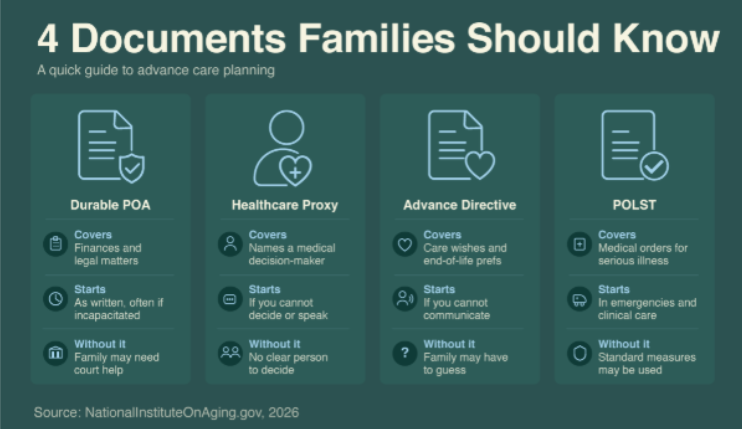
Durable Power of Attorney
A durable power of attorney (POA) designates someone to manage a parent’s financial and legal affairs if the parent becomes unable to do so. The word “durable” is critical: it means the document stays valid even if the person becomes incapacitated. A standard POA becomes void the moment the person loses capacity.3
A springing POA, which only activates upon a formal declaration of incapacity, can cause delays exactly when time matters most.
Healthcare Proxy, Advance Directive, and POLST
A healthcare proxy designates someone to make medical decisions, while an advance directive documents specific treatment preferences in writing.3
The document most families have never heard of is the POLST (Physician Orders for Life-Sustaining Treatment). This is a physician-signed medical order, not just an expression of wishes, that healthcare providers must follow immediately in an emergency.4
For parents managing serious health conditions or advancing age, it is often the most actionable document in the set.
Without these documents in place, a family that needs to make financial or medical decisions on a parent’s behalf must petition the court for guardianship or conservatorship. It is an entirely avoidable outcome as long as the right paperwork is completed ahead of time and filed away until it may be needed.
Organizing the Financial Picture
Even families who have had the conversation and have documents in place often lack a clear picture of a parent’s full financial life. Account numbers, insurance policies, the location of the will, the name of the estate attorney, and the list of monthly automatic payments: these are the details that matter when something happens and can be difficult to reconstruct after the fact.
A family financial inventory, a single, organized record of everything a trusted person would need to step in, is one tool a family can build. The inventory should include bank and investment accounts, insurance policies, pension income, real estate, and professional contacts. Digital access (think user names and passwords) matters too, since most accounts are managed online, and gaining access after a parent loses capacity can be a lengthy process if you haven’t thought it through. Research suggests cognitive changes affecting financial decision-making can begin in their 50s, making early visibility not just useful but protective.5
Elder Financial Exploitation: Closer Than Most Families Think
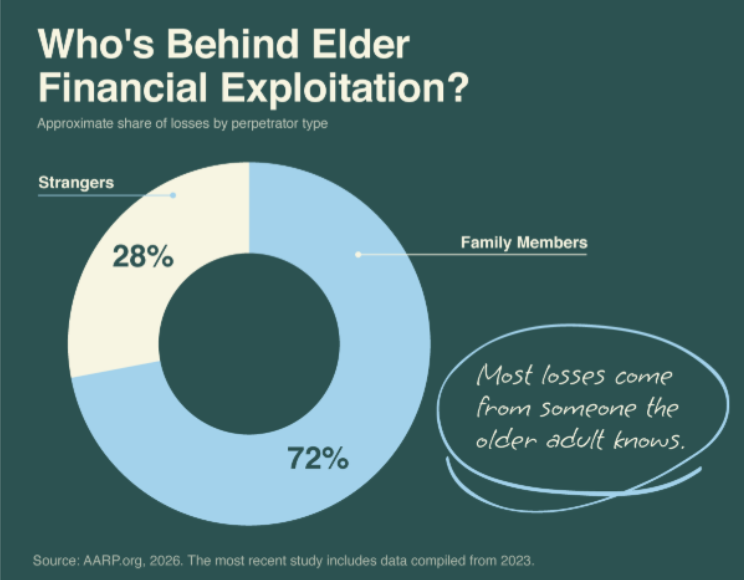
It’s unfortunate, but elder financial exploitation is one of the fastest-growing financial crimes in the country and one of the least reported. According to the most recent AARP Public Policy Institute research, approximately 72 percent of all elder financial exploitation losses, roughly $20.3 billion of that $28.3 billion total, come from known perpetrators: family members, caregivers, and others with trusted access to older adults, rather than from strangers.6
Higher-asset elders are more attractive targets precisely because there is more to take.
Warning signs include unusual withdrawals, new names on financial accounts, sudden changes to a will or beneficiary designations, and unpaid bills despite adequate resources. One approach is structure, not surveillance. A parent who has a clear estate strategy and adult children with some financial visibility can help.
What Medicare Covers, and What to Do When It Runs Out
Healthcare costs continue to rise and can be an unpleasant surprise as parents age. What many do not appreciate is that Medicare does not cover long-term custodial care. It covers short-term skilled nursing facility care after a qualifying hospital stay: fully for the first 20 days, with a daily copay of $217 from days 21 through 100, and nothing after that. It does not cover assisted living or ongoing home care. Why does this matter and need to be addressed? Because 70 percent of Americans over 65 will need some form of extended care, with an average duration of three years.7,8
For some families, Medicaid, which does cover extended care costs, is not a realistic option: it is means-tested, and qualifying can mean spending down well below thresholds most financially comfortable families could ever expect to approach. The two realistic strategies are self-funding, which means treating a potential multi-year care need as a portfolio liability, and financial products, which shift that risk to a financial institution.
How Our Firm Can Help
Our firm can help frame and facilitate difficult conversations. We know professionals who can help review the legal documents in place. We can help model extended care cost scenarios against a family’s specific financial picture and coordinate with estate attorneys when updates are needed.
The families who tend to feel most comfortable about how this chapter goes are the ones who approached it as a proactive exercise rather than a response to a problem. We are glad to be part of that process at whatever stage a family is ready to begin.
Frequently Asked Questions
At What Age Should Families Start Having These Conversations With Their Parents?
There is no single right age, but research suggests financial decision-making can be affected by cognitive changes earlier than you might expect. Starting while parents are healthy and fully engaged, ideally in their 60s or early 70s, gives families the most time and options. The goal is not to intervene early. It is to be organized early.
What Is the Difference Between a Durable Power of Attorney and a Regular Power of Attorney?
A regular POA becomes void the moment the person loses mental capacity. A durable POA remains in effect even then, which is precisely when it is most needed. Most estate attorneys recommend a durable POA. Families should also confirm whether it is already active or only springs into effect upon a formal incapacity declaration, since the latter can cause legal delays when time matters most.
Who Is Most Likely to Commit Elder Financial Exploitation?
Research points to known perpetrators rather than strangers. For some families, the stakes are higher since wealthy elders are more attractive targets. Protecting a parent’s financial interests means establishing clear structures and accountability within the family, not just watching for external threats.
Sources:
1. TrustandWill.com, 2026.
https://trustandwill.com/learn/estate-planning-report-2026
2. TheDecisionLab.com, 2026.
https://thedecisionlab.com/biases/ostrich-effect
3. www.nia.nih.gov, 2026.
4. Connellylaw.com, 2026.
5. pmc.ncbi.nlm.nih.gov, 2026.
https://pmc.ncbi.nlm.nih.gov/articles/PMC6768425/;
6. AARP.org, 2026. https://www.aarp.org/pri/topics/work-finances-retirement/fraud-consumer-protection/scope-elder-financial-exploitation/
7. Medicare.gov, 2026.
https://www.medicare.gov/coverage/skilled-nursing-facility-care
8. JRCInsuranceGroup.com, 2026.
https://www.jrcinsurancegroup.com/long-term-care-statistics/