

Thanksgiving is one of the few weekends when three generations of the same family have been known to sit at the same table for hours at a stretch. Conversations can cover a wide range of subjects, and sometimes the conversation turns to money, and old habits emerge from everyone around the table.
Financial psychologists call the underlying pattern a money script, an unconscious belief about money formed early in life that most people never notice they are still acting on. Researchers have identified four of these scripts, and they predict a family’s financial habits.1
What Is a Money Script, and Who Identified It?
Financial psychologist Brad Klontz and three co-researchers surveyed 422 adults on 72 beliefs about money, ranging from “money is the root of all evil” to “you can never have enough money.” Their analysis grouped those beliefs into four patterns, published as the Klontz Money Script Inventory in the Journal of Financial Therapy. As Klontz explained, most financial behavior will “make perfect sense when we understand the beliefs that are underneath them.”2
What Are the Four Money Scripts?
Money avoidance: money is viewed as bad or dangerous, and wealth as morally suspect, which can lead someone to undermine their own money efforts.1
Money worship: the belief that more money would fix nearly everything, paired with a tendency to overspend, chasing a satisfaction that may never arrive.
Money status: net worth as a stand-in for self-worth, a pattern also linked to a financially strained childhood, not just current income.
Money vigilance: frugality, discretion, and a persistent watchfulness about money that shows up even in people who are otherwise on strong financial footing.
These four are not mutually exclusive. The original study found all four scores move together to some degree, meaning most people carry a blend rather than a single pure type. Someone can be frugal about everyday spending and still status-conscious about the car in the driveway.
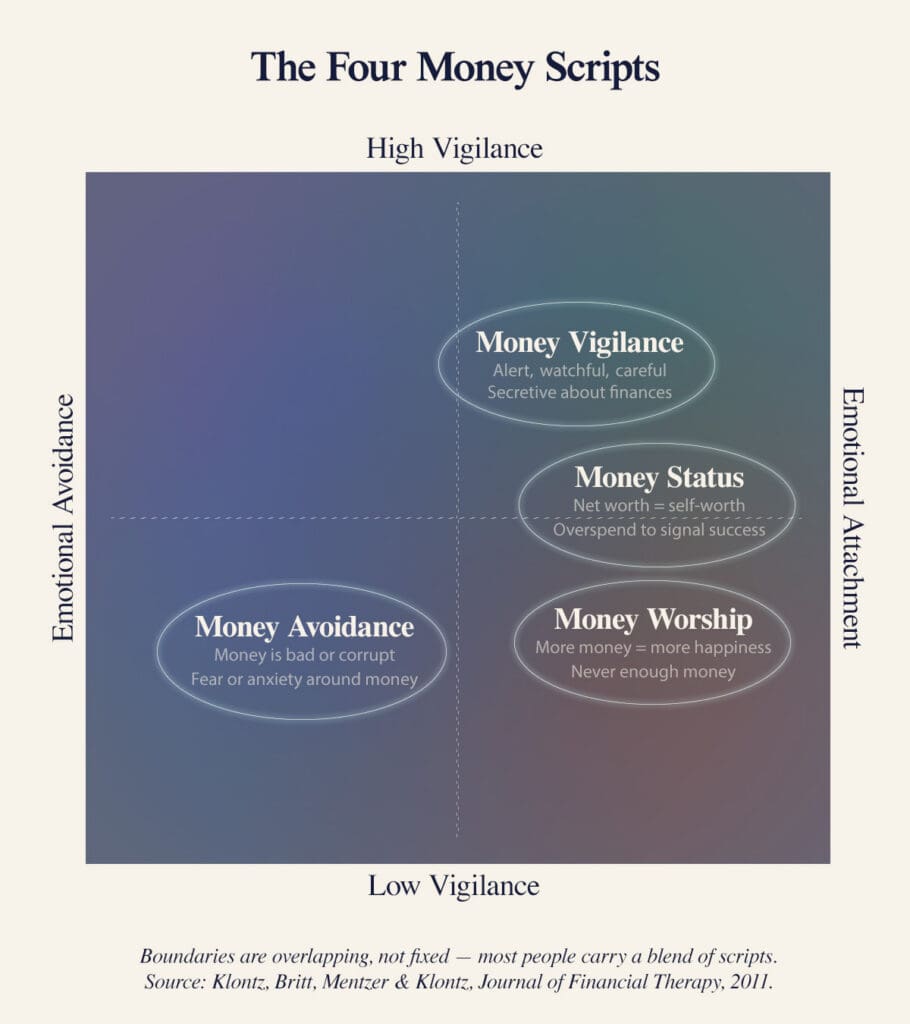
This blog is designed to give you an overview of money scripts and how they can manifest in a family. A financial therapist might be able to help you better understand how money scripts are playing out in your household.
How Scripts Show Up
Two of the four scripts have the clearest ties to income and net worth. Money avoidance was correlated with both lower income and lower net worth, and money worship showed an even stronger tie to lower net worth. Money status was linked to lower income, too, but it was also the only script tied to childhood financial circumstances. People who grew up in households with more financial struggle were more likely to develop a status script as adults, regardless of what they earn now. Klontz has connected that same script directly to spending behavior, noting that people who feel pulled toward status often “overspend and have higher credit card debt.”1,2
Money vigilance did not show the same drag on income or net worth. Klontz describes people who lead with this script as usually financially comfortable but still carrying more anxiety than the numbers suggest. He concluded that “you could be so anxious around money, you hoard it and don’t enjoy life.”1,2
Why Do These Beliefs Form So Early?
A separate study found that the cognitive building blocks behind later financial behavior, including self-control and the ability to apply basic rules about spending and saving, are typically in place by around age seven. Children absorb these patterns by watching, not by being told. A parent who tenses up every time a bill arrives, or who never lets a dollar figure be spoken aloud at the table, teaches a money script more effectively than any lecture about budgeting would. By the time a child is old enough to sit through a real conversation about money, the script is often already running quietly in the background.3
Why Is Money Still the One Topic Families Won’t Discuss at the Table?
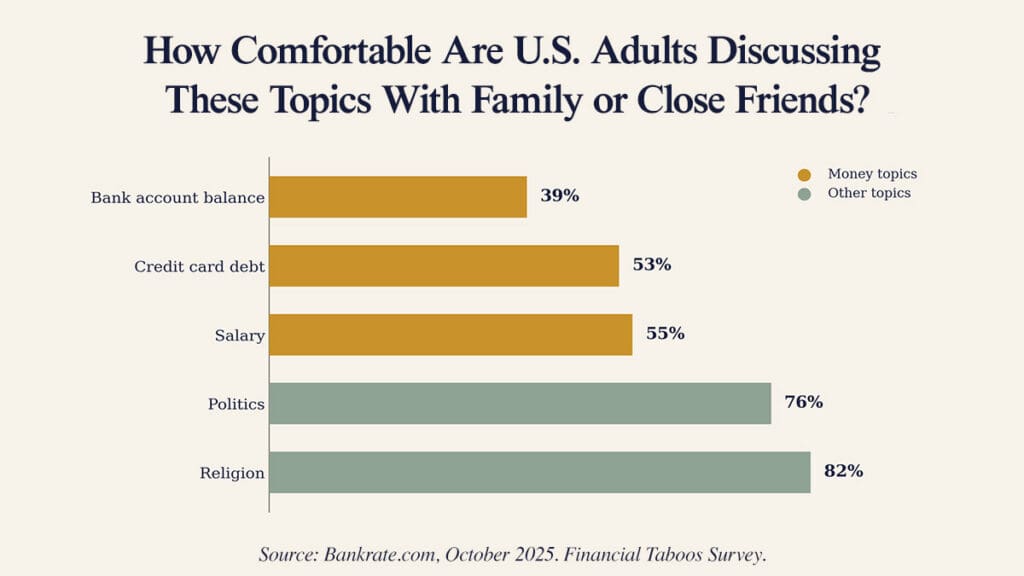
A Bankrate survey found that 14 percent of adults consider money a normal topic of conversation at holiday gatherings, and just 39 percent are comfortable discussing their bank account balance with family or close friends. That discomfort splits by generation. More than half of Gen Z and over 40 percent of Millennials said they were at ease discussing their account balances, compared with about a third of Gen Xers. That decision to stay quiet is itself a script, most likely avoidance or vigilance, being modeled to a new generation at the exact table where naming it might do more good.4
What Happens When Parents Never Talk to Their Adult Kids About Money at All?
The clearest example of a family money script playing out in real time may be the current intergenerational wealth transfer.
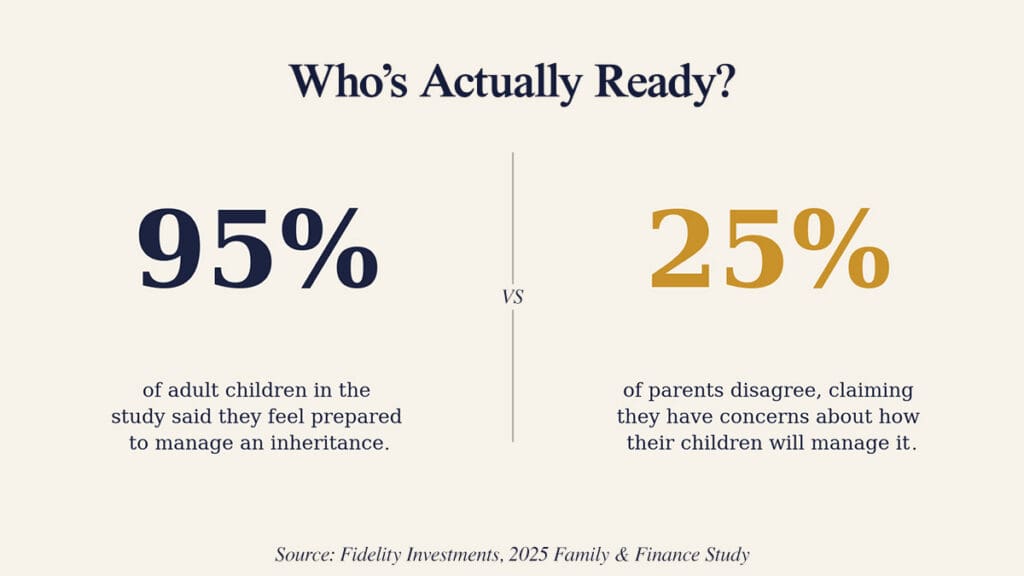
Fidelity Investments’ Family and Finance Study found that 68 percent of parents age 55 and older with at least $500,000 in investable assets have not told their adult children what they stand to inherit or whether they will inherit anything at all. Fifty-two percent have not discussed their net worth with their kids in any form. The two generations do not even agree on how ready anyone is for this handoff: 95 percent of adult children in the study said they feel prepared to manage an inheritance, but 25 percent of parents disagree, claiming they have concerns about how their children will manage their inheritance. A child who is told nothing about money learns one clear lesson: that money is not something this family discusses.5
How Might a Family Use This Around the Table This Year?
Klontz’s own suggestion is simple: treat your own family like a research subject for an afternoon. Notice the moment someone reacts to a number, a shrug, or a flash of real tension, and ask what belief might be sitting underneath it rather than what the number itself is. Financial therapists use a formal version of this, called a financial genogram, a family tree that maps money beliefs and behaviors across generations rather than birthdates and anniversaries. A family does not need a therapist’s worksheet to borrow the underlying idea. Naming a pattern out loud, even just to a spouse on the drive home, tends to do more good than trying to fix it on the spot.
How Our Firm Can Help
We build financial plans around behavior as much as around numbers. When a client’s spending, saving, or reluctance to open a statement traces back to a script they inherited rather than a decision they made on purpose, naming it changes the conversation. For families in the middle of passing wealth to the next generation, we help structure the disclosure itself—what to share and when—so an inheritance does not arrive as a surprise attached to decades of unspoken assumptions.
Frequently Asked Questions
What is a money script, in plain terms?
A money script is an unconscious belief about money, usually formed in childhood, that continues to shape spending, saving, and financial decisions well into adulthood, often without the person realizing it.1,2
Which money script is the healthiest one to have?
Researchers treat money vigilance, marked by frugality and discretion, as the least financially damaging of the four. It is not risk-free. People with this script often carry more financial anxiety than their actual net worth would justify.1,2
Can someone have more than one money script?
Yes. The original research found that the four scripts are positively correlated with one another, indicating that most people exhibit a blend rather than a single, pure type.1,2
Is a family’s silence about money a real problem, or is that just privacy?
Some privacy is reasonable. But research on family wealth transfers shows that when parents share almost nothing about their finances or their plans, adult children are left assuming rather than knowing, which can set the stage for confusion or conflict later.1,2
How do we bring this up without turning Thanksgiving into a personal finance meeting?
Klontz’s own guidance is to observe rather than diagnose. Notice a reaction and treat it as a shared family trait rather than something to fix at the dinner table.1,2
1. Journals.newprairiepress.org, 2026. (Based on a study that was initially conducted in 2011.)
https://newprairiepress.org/jft/vol2/iss1/1/
2. CNBC.com, 2026. (The interview with Klontz took place in 2023.)
https://www.cnbc.com/2023/04/11/to-improve-your-finances-learn-your-money-script-psychologist-says.html
3. MoneyandPensionsService.org.uk, 2026.
https://moneyandpensionsservice.org.uk/wp-content/uploads/2021/03/the-money-advice-service-habit-formation-and-learning-in-young-children-may-2013.pdf
4. Bankrate.com, 2026.
https://www.bankrate.com/banking/financial-taboos-survey/
5. Fidelity.com, 2025.
https://newsroom.fidelity.com/pressreleases/fidelity–study-finds-the-great-wealth-transfer-leaves-families-poised-to-build-stronger-financial-f/s/3c72b6d3-9ab6-400a-95e7-f4b30e43db64